
Background and need for research
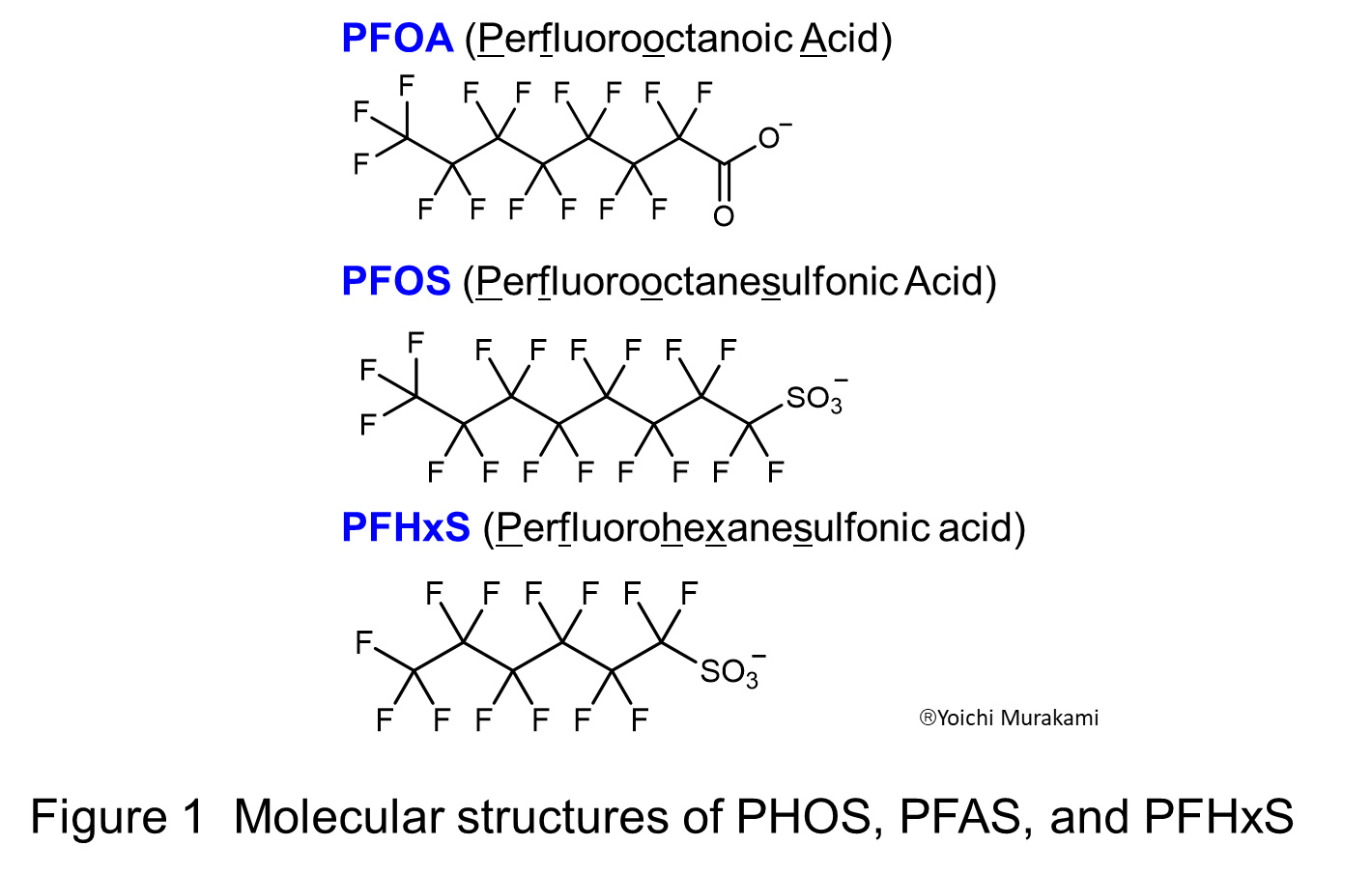
The number of news articles on Google News with PFAS in the title has recently surged, reporting on people’s concerns on a global scale. The Stockholm Convention on Persistent Organic Pollutants (POPs) regulates PFOA and PFOS with a carbon chain length of 8 (C = 8), PFHxS with 6 carbon atoms, and long-chain PFCAs with 9-21 carbon atoms. In Japan, for example, the three types shown in Fig. 1 are regulated. In response to these regulations, the use of short-chain PFAS with less than 6 carbon atoms has been expanding both domestically and internationally in recent years, but it is beginning to be shown that such short-chain PFAS may also have similar harmful effects (Environ. Sci. Europe 2018, Chem. Eng. J. 2020, Results in Chem. 2026, J. Hazard. Mater. Adv. 2026).
The European Chemicals Agency (ECHA) is currently considering a comprehensive regulation of PFAS, including short-chain PFAS (ECHA News 1, News 2, Document, 2026). There are three problems with granular activated carbon (GAC), the current primary capture technology for PFAS; they are, (1) it is difficult to regenerate (i.e., remove the captured PFAS so that the material can be reused), so it is usually incinerated, which is energy inefficient, (2) the combustion of activated carbon and fuel releases a large amount of CO2, which is irrational from a decarbonization standpoint, and (3) in principle it cannot capture short-chain PFAS. Many technologies that claim to regenerate activated carbon or decompose PFAS merely involve shortening the chain from C = 8, and simply breaking the chain does not fundamentally solve the problem. A fundamental solution requires regenerating the material in a low-cost and environmentally friendly way, and then mineralizing the PFAS after concentration, but such technology does not currently exist.
Against this social backdrop, it is necessary to create a “cost- and energy-efficient PFAS removal material base” that can capture and concentrate PFAS, taking into account connectivity to the subsequent mineralization treatment of PFAS, and is capable of handling not only the three types of PFAS currently under regulation (Fig. 1) but also short-chain PFAS with less than C = 6, which are expected to be subject to international regulation in the near future. Our aim is to create new materials for this purpose, demonstrate their practicality on a lab-to-bench scale, and mitigate the water pollution problem and potential risks (For example, Environ. Sci. Pollut. Res. 2026) that humanity faces. Simultaneously, we aim to foster related environmental industries, thereby contributing to improved safety and security for people and the development of industry.
Problems with existing technologies and points that require improvement
Current PFAS capture technology, granular activated carbon (GAC), has several problems: it is often disposable and incinerated without being recycled, resulting in excessive CO2 emissions; it is inherently difficult to capture short-chain PFAS (J. Water Process Eng. 2023, Chemosphere 2024); it has low selectivity for PFAS, leading to frequent replacement; and there are concerns about the generation of short-chain PFAS due to partial decomposition during incineration and their release into the atmosphere. Similarly, current anion exchange resins face the same problems when disposed of by incineration; when recycled and reused, they require high-cost and environmentally unfriendly regeneration methods using organic solvents such as methanol; and the connectivity of the PFAS solution produced after regeneration to destructive treatment is not always guaranteed. To solve these problems with current technologies, the use of various porous materials is currently being researched.
A prime example of such a material is the metal-organic framework (MOF), which was the subject of the 2025 Nobel Prize in Chemistry. Because MOFs are formed by coordinate bonds (which have a strength between covalent bonds and hydrogen bonds) connecting organic ligands and metal atoms, they generally have lower durability (including water resistance) compared to materials formed by covalent bonds (Chem. Rev. 2020, section 5.2.3). Furthermore, MOFs contain metals. Several papers reporting PFAS capture using MOFs have used highly toxic aquatic organisms such as chromium and copper (Inorg. Chem. 2019, Matter 2022, Small 2025), and radioactive Thorium (Nature Commun. 2017) (while some other MOFs use zirconium, iron, zinc, etc.), while harmful zirconium tetrachloride (ACS Sust. Chem. Eng. 2019) and fluorine-based ligands (trifluoroacetic acid, Adv. Funct. Mater. 2024) that can themselves become PFAS have been used as organic ligands. Regarding these issues, for example, a review paper on PFAS capture by a certain MOF (ChemSusChem, 2022) states that “Many metals and ligands that MOFs are composed of are toxic, especially to aquatic life (e.g., copper).” Another review paper (Langmuir, 2024) states that “the synthesis process of MOFs can often involve the use of chemicals that may be harmful to the environment.” Furthermore, MOFs are more expensive than other porous materials. For example, one review article (Mater. Chem. Front. 2024) states that the current production costs of MOF-5, MOF-177, and MOF-210 are US$200,000/ton, US$130,000/ton, and US$200 million/ton, respectively. In addition, most previous studies on PFAS capture using MOFs (Chem. Mater. 2021 , Langmuir 2023, Langmuir, 2024, J. Am. Chem. Soc. 2024, Small 2025, Adv. Mater. 2025) have used a high-cost and environmentally concerning regeneration method using methanol, and this regeneration method is not suitable for large-scale social deployment.
In zeolites, which are inorganic and porous crystalline aluminosilicates, reports demonstrating high PFAS adsorption capacity have all used high-silica (Si/Al > 100-200) zeolites (Angew. Chem. Int. Ed. 2020, ACS Appl. Mater. Interf. 2023, Water Res. Technol. 2023). The capture mechanism is hydrophobic interaction with the perfluoroalkyl chain (ACS Appl. Mater. Interf. 2023, Ind. Eng. Chem. Res. 2024). Therefore, there is an issue in that the adsorption capacity is low for short-chain PFAS, which require an electrostatic interaction mechanism (Ind. Eng. Chem. Res. 2024). The reason why increasing the Al ratio cannot enhance electrostatic interaction is that high-Al zeolites have low durability and thermal stability (Stud. Surf. Sci. Catal. 1995, Chem. Sci. 2021). In fact, a paper comparing the performance of all-silica zeolites (Si:Al = ∞) and high-aluminum zeolites (Si:Al = 100 and 22) (Angew. Chem. Int. Ed. 2020) showed that the PFAS adsorption performance of high-Al ratio zeolites was significantly lower than that of all-silica zeolites, and the reason given was the increase in structural defects due to the high Al ratio. Furthermore, papers applying zeolites to PFAS capture employ a thermal regeneration method using heating to 300-800°C (Angew. Chem. Int. Ed. 2020, ACS Appl. Mater. Interf. 2023, Water Res. Technol. 2023, Ind. Eng. Chem. Res. 2024), but this has the following three problems: 1. Because it is necessary to raise the temperature of the zeolite itself, which has a large heat capacity, and the crystalline water strongly adsorbed in its pores (usually 10-30% by weight, Ind. Eng. Chem. Res. 2025), a large amount of thermal energy is required for regeneration. 2. In this temperature range, PFAS partially decomposes, leading to shortening of the PFAS chain. Related to this, the literature (Ind. Eng. Chem. Res. 2025) states, “The degradation is likely not full mineralization of the PFAS but a transition into various fluorocarbons.” Other papers also did not to show what the original PFAS was transformed into after thermal regeneration. 3. Zeolite appreciably degrades upon thermal regeneration (Ind. Eng. Chem. Res. 2025).
Covalent Organic Frameworks (COFs) being studied by our group are the newest genre of organic porous material (c&en, 2026), offering advantages such as high design flexibility, a composition consisting only of inexpensive and harmless light elements (C, H, O, N, etc.), and being metal-free. However, examples of PFAS capture using COFs (Nature Commun. 2024, Small 2024) have used very expensive starting building block molecules. Furthermore, there were challenges such as the fact that the validation was limited to C = 8 PFOA and involved the regeneration using costly and toxic methanol (Nature Commun. 2024), and that the selectivity for short-chain PFAS was low and methanol regeneration was required (Small 2024).
Idea and aim
In order to realize PFAS capture technology that can be deployed with economic and social rationality, we believe that it is necessary to create materials that meet the following requirements 1 to 5: 1. The material must be metal-free and consist only of light elements. However, it must not contain fluorine (F), which poses a risk of secondary contamination. 2. It must consist of highly durable covalent bonds. 3. It must use raw materials that are as inexpensive as possible. 4. Organic solvents such as methanol, which are expensive and have a high environmental impact, must not be used for material regeneration. 5. In anticipation of the progress of the European comprehensive regulation of PFAS and the possibility that short-chain PFAS may also be subject to regulation, the material must have an electrostatic-force-based capture mechanism necessary for capturing short-chain PFAS.
To meet these requirements, our research group is pursuing the creation of covalent organic porous materials with a cationic skeleton, leveraging the material synthesis knowledge and evaluation techniques cultivated through COF research. Furthermore, the selection of regeneration methods takes into account their connectivity to the subsequent destructive treatment that mineralizes PFAS. We believe that this goal is achievable through rational trials based on the scientific knowledge accumulated to date.